

 服务热线 18617145297
便携式逆变器与便携储能电源安全新规与 AS/NZS 4763:2011 的全面对比(中英对照)
AS/NZS 60335.2.202:2026 — Particular Requirements for Portable Inverters and Portable Power Stations
A Side-by-Side Comparison with AS/NZS 4763:2011
On 29 October 2026, Standards Australia and Standards New Zealand published AS/NZS 60335.2.202:2026, Household and similar electrical appliances — Safety, Part 2.202: Particular requirements for portable inverters and portable power stations. The standard will supersede AS/NZS 4763:2011 three years after the date of publication.
2026年10月29日,澳大利亚标准协会与新西兰标准机构联合发布 AS/NZS 60335.2.202:2026《家用和类似用途电器——安全——第2.202部分:便携式逆变器和便携式储能电源的特殊要求》。该标准将在发布之日起三年后取代现行标准 AS/NZS 4763:2011。
This is not an amendment of the old text. AS/NZS 4763(Int):2006 was first re-designated as AS/NZS 4763:2011, and is now jointly revised and re-designated as AS/NZS 60335.2.202:2026 — a much broader rewrite in scope, structure and technical content.
这不是一次文本修订,而是一次“换体系”的重新编号:AS/NZS 4763(Int):2006 先改编号为 AS/NZS 4763:2011,本次再经联合修订、重新编号为 AS/NZS 60335.2.202:2026。新标准在适用范围、结构和技术内容上都作了大幅扩写。
For manufacturers, importers and certification bodies, the practical question is simple: what must change on the product, in the test programme, and in the manual. This article compares the two editions clause by clause.
对制造商、进口商和认证机构而言,真正要回答的问题只有一个:产品、测试方案和说明书分别要改什么。本文按条款逐一对照两版标准,给出可直接落地的差异清单。
01
PART
一、体系之变:从独立标准到 60335 家族成员 / From a Standalone Standard to a 60335 Family Member
AS/NZS 4763:2011 is a standalone standard with its own clause structure (Scope, Marking, Heating, Short circuit and overload protection, Construction, and so on) in the classical approval-and-test style. AS/NZS 60335.2.202:2026 is instead Part 2 of the AS/NZS 60335 series, to be used together with AS/NZS 60335.1:2022.
AS/NZS 4763:2011 是一部独立标准,拥有自己的条款体系(范围、标志、温升、短路与过载保护、结构等),属于典型的“批准与试验规范”体例。AS/NZS 60335.2.202:2026 则是 AS/NZS 60335 系列的第2部分,必须与 AS/NZS 60335.1:2022 配合使用。
AS/NZS 60335.1:2022 is a modified adoption of IEC 60335-1:2020, Ed. 6.0. Consequently every general requirement of Part 1 applies unless this Part 2 expressly adds, modifies or replaces it — including the numbering system, the temperature-rise tables, the abnormal-operation fault list, and Annex B and Annex R.
AS/NZS 60335.1:2022 是 IEC 60335-1:2020 第6.0版的修改采用版。因此,除本第2部分明确作出“增补、修改、替换”的条款外,第1部分的全部通用要求均适用——包括编号规则、温升表、异常工作故障清单,以及附录B(电池供电器具)和附录R(软件评估)。
The consequence is practical rather than cosmetic: the test logic, the report structure and the compliance evidence now follow the same architecture as the rest of the IEC 60335 family, so existing 60335 capability, CB schemes and laboratory workflows can be reused.
这一变化是实操层面的,而非形式层面的:试验逻辑、报告结构和符合性证据都并入 IEC 60335 系列的同一套架构,企业已有的 60335 技术能力、CB 体系文件与实验室流程可以直接复用。
Note also that the document cannot be read on its own. It is 44 pages precisely because it delegates the bulk of the requirements to Part 1.
同时要注意,新标准不能单独阅读。它只有44页,正是因为它把大量基础要求“委托”给了第1部分。
02
PART
二、适用范围:从 60 VDC、3 kVA 到 250 VDC 的全面扩容 / Scope: From 60 V DC and 3 kVA to 250 V DC
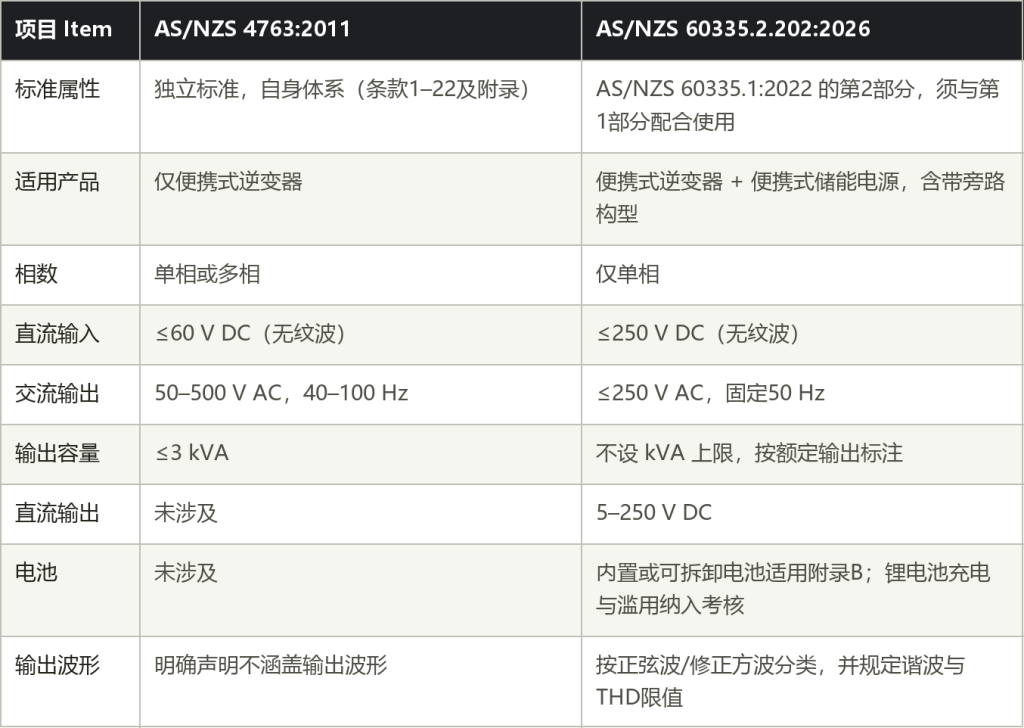
The old scope was narrow and inverter-centric: single-phase or polyphase, air-cooled portable inverters with a rated supply voltage not exceeding 60 V ripple-free DC, a rated output not exceeding 3 kVA, an AC output of 50 V to 500 V, and an output frequency of 40 Hz to 100 Hz.
旧版范围窄且只针对逆变器:单相或多相、风冷(自然或强制)便携式逆变器,额定电源电压不超过60 V 无纹波直流,额定输出不超过3 kVA,交流输出电压在50 V至500 V之间,输出频率在40 Hz至100 Hz之间。
The new scope keeps only the single-phase, air-cooled condition and widens everything else: DC input up to 250 V, AC output up to 250 V at a fixed 50 Hz, DC outputs from 5 V to 250 V DC, no kVA ceiling, and two entirely new product families — power stations with integral or detachable batteries, and appliances with pass-through.
新范围只保留了“单相、风冷”这一条件,其余全部放宽:直流输入最高250 V,交流输出最高250 V且固定为50 Hz,直流输出覆盖5 V至250 V,不再设 kVA 上限,并新增两个完整的产品族——带内置或可拆卸电池的储能电源,以及带旁路(pass-through)功能的器具。
Two details deserve attention. First, the AC frequency is now fixed at 50 Hz, so this standard cannot be applied as-is to 60 Hz markets. Second, the absence of a kVA limit means high-capacity power stations are now inside the scope rather than outside it.
有两处细节值得注意。第一,交流频率被固定为50 Hz,因此本标准不能直接套用于60 Hz 市场。第二,取消 kVA 上限,意味着大容量储能电源从“范围之外”变成了“范围之内”。
表1 适用范围对比 / Table 1 — Comparison of scope
The exclusion list has also been rewritten. Semiconductor motor controllers (IEC 60947-4-2), UPS inverters (IEC 62040), grid-connected inverters (AS/NZS 4777.2), emergency lighting inverters (AS/NZS 2293), battery chargers (AS/NZS 60335.2.29) and low-voltage power banks for audio/video and IT equipment (AS/NZS 62368.1) remain outside.
排除清单同样重写。半导体电动机控制器与起动器(IEC 60947-4-2)、UPS 用逆变器(IEC 62040 系列)、并网逆变器(AS/NZS 4777.2)、建筑应急照明与出口标志用逆变器(AS/NZS 2293 系列)、电池充电器(AS/NZS 60335.2.29),以及音视频与信息技术用特低电压移动电源(AS/NZS 62368.1),仍在范围之外。
03
PART
三、产品分类:六种构型与两种波形 / Classification: Six Configurations and Two Waveforms
Clause 6.1 removes the shock-protection classification altogether: inverters and power stations are no longer classified as Class I, II or III. Protection against electric shock is instead delivered through the insulation coordination requirements of 22.101 to 22.103.
第6.1条取消了防电击分类:逆变器与储能电源不再按Ⅰ类、Ⅱ类、Ⅲ类划分。防电击改由 22.101 至 22.103 的绝缘配合要求来保证。
Clause 6.101 requires every appliance to be assigned to one of six configurations, and clause 6.102 requires the output waveform to be declared as either sine wave or modified square wave. The configuration determines which insulation clause applies.
第6.101条要求每台器具必须归入六种构型之一,第6.102条要求声明输出波形为“正弦波”或“修正方波”。构型直接决定适用哪一条绝缘条款。
表2 产品构型与绝缘要求 / Table 2 — Configurations and insulation requirements
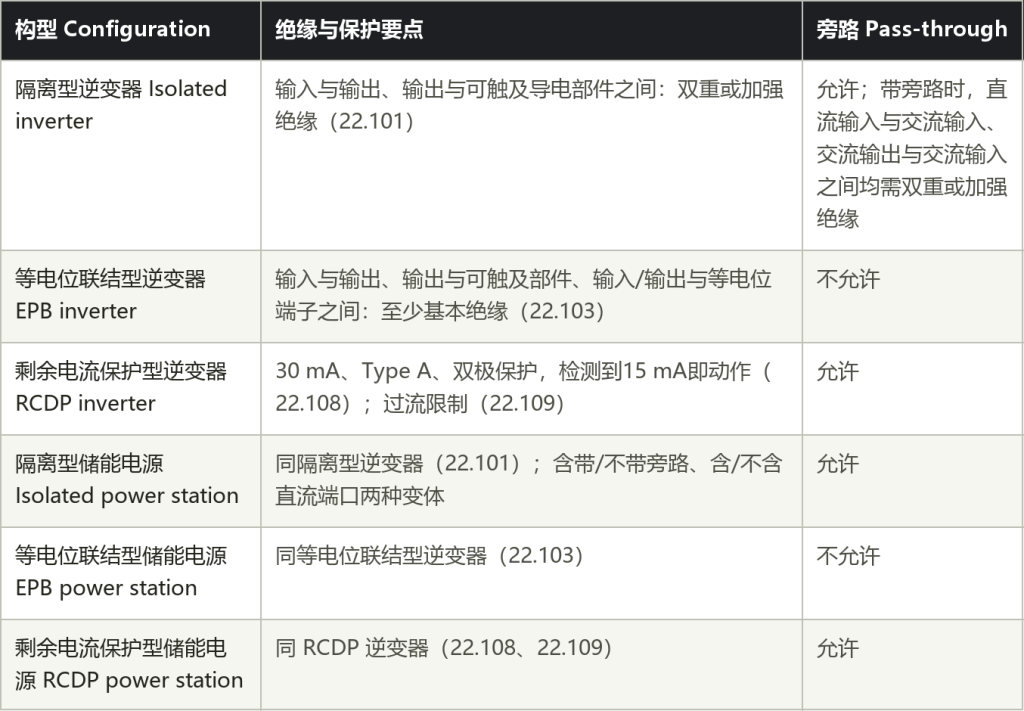
Annex AA illustrates seven typical arrangements, and notes that any appliance may carry one or more socket-outlets or appliance outlets irrespective of the example shown.
附录AA 给出了七种典型接线示例,并注明:无论示例如何,任何器具都可以配置一个或多个插座或器具插座。
04
PART
四、关键技术要求的八个变化点 / Eight Technical Changes That Matter4.1高温工况成为设计基准 / High Ambient Temperature Becomes the Design Baseline
Clause 5.7 requires the tests of clauses 11, 13, 18.101 and 19 to be carried out at 50 °C ± 5 °C, at 30 °C ± 5 °C, or at the operational ambient temperature declared in the instructions ± 5 °C, whichever is the most unfavourable.
第5.7条要求第11、13、18.101和19章的试验在下列温度中进行:50 °C ± 5 °C、30 °C ± 5 °C,或说明书声明的使用环境温度 ± 5 °C,取最不利者。
Clause 11.8 reduces the Part 1 temperature-rise limits by 5 K when testing at 30 °C, by 25 K when testing at 50 °C, and by (declared ambient − 25) K when testing at the declared ambient.
第11.8条规定,第1部分的温升限值在30 °C环境试验时降低5 K,在50 °C环境试验时降低25 K,在声明的环境温度下试验时降低(声明温度 − 25)K。
Clause 7.1 then follows through on the marking side: the rated output in volt-amperes, or the rated output current, must be declared together with the ambient temperature at which that rating applies — separately for 50 °C and for 30 °C.
第7.1条在标志端作了配套:额定输出(以伏安计)或额定输出电流,必须与其适用的环境温度一同标注,且50 °C与30 °C须分别标注。
This is the single most disruptive change for hardware design. A product rated “2000 W” without an ambient qualifier no longer satisfies the marking requirement, and a thermal design validated only at 25 °C will not pass the heating test.
这是对硬件设计冲击最大的一条。仅标“2000 W”而不注明环境温度,已不再满足标志要求;只在25 °C下验证过的热设计,也过不了温升试验。4.2IP 等级首次与使用场所绑定 / IP Rating Tied to the Place of Use
Clause 6.2 adds a minimum degree of protection: inverters for indoor use shall be at least IP20, and power stations for outdoor use shall be at least IP24.
第6.2条新增最低防护等级要求:室内用逆变器至少 IP20,室外用储能电源至少 IP24。
IP24 closes the door on a common design shortcut — outdoor-capable power stations built on an open-frame or unfiltered ventilation architecture — because the second digit now requires protection against splashing water.
IP24 关闭了一条常见的设计捷径——以开放式框架或无过滤通风结构宣称“可户外使用”的储能电源,因为第二位特征数字现在要求防溅水。4.3输出接口与输出特性 / Output Outlets and Output Characteristics
Clause 22.61 restricts user-accessible socket-outlets to single-phase types rated not more than 16 A, complying with AS/NZS 3112 at 10 A or 15 A and suitable for three-pin flat-pin plugs to Figure 2.1(a1). Appliance outlets shall comply with AS/NZS 60320.3, earthed configuration types F, N and P.
第22.61条限定用户可触及的插座为单相、额定电流不超过16 A,须符合 AS/NZS 3112 的10 A或15 A规格,并适用于符合 AS/NZS 3112 图2.1(a1) 的三脚扁插头。器具插座须符合 AS/NZS 60320.3 中带接地的 F、N、P 型。
Each outlet must be protected by a circuit breaker for equipment to IEC 60934 or a non-user-replaceable fuse-link, rated not more than the appliance rated output current, and placed behind a non-detachable cover.
每个插座必须由符合 IEC 60934 的器具用断路器,或不可由用户更换的熔断器保护,其额定值不超过器具额定输出电流,并置于不可拆卸的罩壳之后。
A narrow exemption exists for appliances rated not more than 120 W whose voltage collapses when rated output is exceeded, verified by loading at 136 % for up to two hours and 600 % for up to five seconds, with the output collapsing below 180 V each time.
对额定输出不超过120 W、且在超出额定输出时电压崩塌的器具设有窄口径豁免,需以136 % 负载持续两小时、600 % 负载持续五秒验证,且每次输出电压均须崩塌至180 V以下。
Clause 22.114 adds an output-quality requirement: from no load to rated output, the output voltage shall not deviate from the rated value by more than 10 %, and the peak shall not exceed 110 % of the peak of a sine wave of the same RMS value.
第22.114条新增输出品质要求:从空载到额定输出,输出电压偏离额定值不得超过10 %,峰值不得超过同有效值正弦波峰值的110 %。4.4剩余电流保护与泄漏电流 / Residual Current Protection and Leakage Current
For RCD-protected types, clause 22.108 requires double-pole, 30 mA, Type A residual current detecting circuitry that is functionally dependent on the line voltage, and that disconnects the output when the current difference exceeds 15 mA, within the time limits of AS/NZS 61008.1:2015+A1:2024.
对 RCD 保护型产品,第22.108条要求配置双极、30 mA、Type A 的剩余电流检测电路,且功能上依赖线路电压;当检测电流差超过15 mA时,须在 AS/NZS 61008.1:2015+A1:2024 表1、表2 规定的时间内断开输出。
Clause 22.107 requires a test device so that the user can periodically verify the detection circuitry — 25 manual operations at five-second intervals, each operating without delay.
第22.107条要求设置试验装置,供使用者定期验证检测电路功能——以5秒间隔手动操作25次,每次均应无延时动作。
Clause 13.2 sets the operating-temperature leakage current at 5 mA peak, measured between any pole of the AC output and accessible conductive parts, DC supply connections and SELV outputs, with the neutral/earth connection removed for RCDP types.
第13.2条将工作温度下的泄漏电流限定为5 mA 峰值,测量点为交流输出任一极与可触及导电部件、直流电源接线端子、SELV 输出之间;对 RCDP 型产品,测量时须断开中性线与接地线的连接。
Clauses 22.111 to 22.113 add three transient touch-current limits of 3.5 mA: after disconnection of the AC input connector, at the appliance inlet of a pass-through appliance, and between input supply terminals of a battery-operated power station.
第22.111至22.113条新增三项3.5 mA 的瞬态接触电流限值:断开交流输入连接器后、带旁路器具拔脱进线连接器后,以及电池供电储能电源各输入端子之间。
Clause 22.111 additionally caps the residual voltage across the AC input terminals at 34 V one second after disconnection, measured with an instrument of at least 100 MΩ in parallel with no more than 25 pF.
第22.111条另规定:断开1秒后,交流输入端子间的残余电压不得超过34 V,测量仪器输入阻抗不低于100 MΩ、并联输入电容不超过25 pF。4.5波形与谐波:从“不涵盖”到“量化限值” / Waveform and Harmonics: From Excluded to Quantified
The 2011 edition expressly stated that it did not cover the output wave shape. The 2026 edition quantifies it, splitting products into sine wave and modified square wave and setting limits for each.
2011版明确声明“不涵盖输出波形”。2026版则对其作了量化:把产品分为正弦波与修正方波两类,并分别设定限值。
For sine wave output, clause 22.104 applies Table 101 to the no-load output voltage and Tables 102 and 103 to the output current at 100 % and 50 % of rated current.
对正弦波输出,第22.104条对空载输出电压适用表101,对100 % 和50 % 额定输出电流下的输出电流分别适用表102和表103。
表3 输出电压谐波限值(表101)/ Table 3 — Output voltage harmonic limits (Table 101)
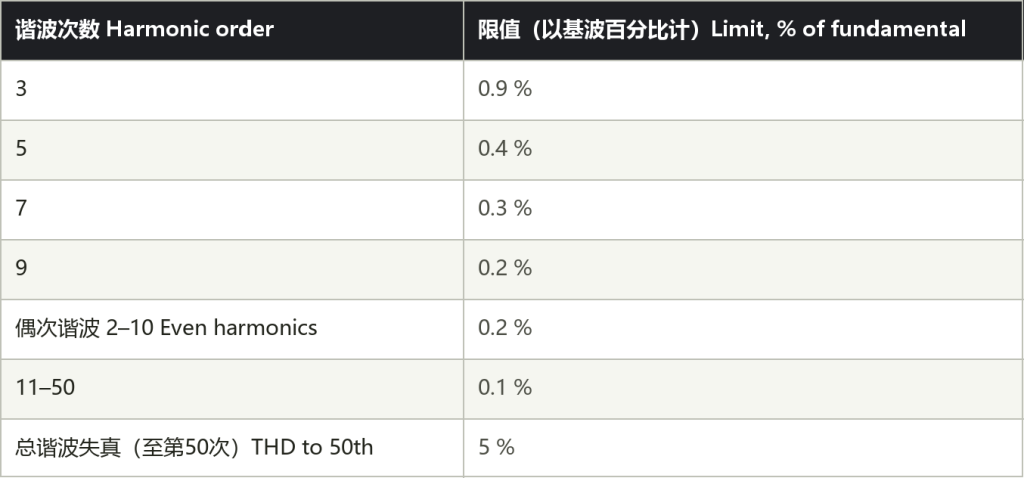
For modified square wave output, clause 22.105 requires a total harmonic distortion not exceeding 5 % and no individual harmonic above 5 %, measured at 5 %, 50 % and 100 % of rated current into a resistive load.
对修正方波输出,第22.105条要求总谐波失真不超过5 %,且任一单次谐波不超过5 %,在5 %、50 %、100 % 额定电流的阻性负载条件下测量。
Clause 7.12 adds a corresponding instruction duty: if the output is a modified square wave, the manual must state which types of equipment are not suitable for connection, with the induction-motor heating and loss example given in the standard.
第7.12条增加了对应的说明书义务:若输出为修正方波,说明书须说明哪些类型的设备不适于接入,标准中给出的示例是感应电动机会因损耗增加而过热,能效与寿命随之下降。4.6机械强度:1.0 J 冲击、1 m 跌落与随机振动 / Mechanical Strength: 1.0 J, 1 m and Random Vibration
Clause 21.1 raises the impact energy to 1.0 J ± 0.05 J, a value well above the Part 1 default used for most household appliances.
第21.1条将冲击能量提高至1.0 J ± 0.05 J,明显高于第1部分对多数家用器具的默认值。
Clause 21.101 adds a free-fall test for appliances not exceeding 18 kg: three appliances, dropped from 1 m, each in a different orientation, per IEC 60068-2-31 procedure 1. Clause 5.2 allows three additional samples for this test.
第21.101条新增自由跌落试验,适用于质量不超过18 kg 的器具:三台样品,自1 m 高度跌落,每台取向不同,按 IEC 60068-2-31 程序1进行。第5.2条允许该项试验增加三台样品。
Clause 21.102 adds a vibration test to IEC 60068-2-64, Annex A Table A.1 Category 4 “portable equipment operating”, with the sample built into an approximately 20 mm plywood enclosure of the minimum internal dimensions stated in the installation instructions.
第21.102条新增振动试验,按 IEC 60068-2-64 附录A 表A.1 第4类“便携式设备工作状态”执行;样品须装入约20 mm 厚的胶合板箱内,箱体内部尺寸取安装说明书中声明的最小值。
Both tests share the same acceptance criteria: no damage impairing compliance with clauses 8.1, 15.1.1, 16.3 and 29, and, for vibration, no connections worked loose.
两项试验采用相同的合格判据:不得出现影响 8.1、15.1.1、16.3 和29章符合性的损伤;振动试验后连接还应无松动。4.7锂电池:充电、滥用与结构限制 / Lithium Batteries: Charging, Abuse and Construction Limits
Clause 12 now applies the Part 1 requirements for metal-ion battery charging, tested at 50 °C ± 5 °C regardless of the charging temperature range declared in the instructions, and repeated at the declared extremes where these fall outside 10 °C to 50 °C.
第12章引入第1部分关于金属离子电池充电的要求,试验在50 °C ± 5 °C 下进行,不论说明书声明的充电温度范围如何;若声明的极值超出10 °C至50 °C,还须在极值处重复试验。
Clause 19.103 adds three overcharge tests: charge voltage raised 10 % above the upper limit per cell (19.103.1), charge current at 120 % of the maximum (19.103.2), and charging with vents blocked and cooling fans disabled (19.103.3). Every case requires no fire, no explosion and no venting, with monitoring continued for one hour after charging stops.
第19.103条新增三项过充试验:充电电压超过每节上限10 %(19.103.1)、充电电流达到最大值120 %(19.103.2)、封堵通气口并停用冷却风扇后充电(19.103.3)。三种情形均要求不起火、不爆炸、不泄气,且充电停止后仍须继续监测一小时。
Clause 19.104 adds an abnormal ambient test at 70 °C ± 5 °C for eight hours at rated output, during which the appliance shall not emit flames, molten metal, or poisonous or ignitable gases in hazardous amounts.
第19.104条新增异常环境温度试验:在70 °C ± 5 °C 下以额定输出运行八小时,期间不得喷出火焰、熔融金属,或危险量的有毒、可燃气体。
Annex B carries a construction restriction that matters commercially: configurations c), d) and f) of Figure B.1 are not allowed for power stations, and the isolation threshold is raised from 42.4 V to 60 V.
附录B含有一条影响产品形态的结构限制:图B.1 中的 c)、d)、f) 三种结构不允许用于储能电源;同时隔离判定阈值由42.4 V 提高至60 V。
Clause 5.10 adds a documentation duty: where metal-ion batteries are used, the manufacturer or responsible agent shall provide the safety data sheet for each battery type.
第5.10条增加文件义务:使用金属离子电池时,制造商或责任代理须提供每种电池的安全数据表。4.8旁路转换与直流侧连接 / Pass-through Changeover and DC Connections
Clause 18.101 replaces the entire endurance clause with a changeover reliability test: ten minutes at rated output from rated input, disconnect the input and sustain the output from the battery for a further ten minutes, then reconnect — repeated 100 times.
第18.101条以转换可靠性试验整章替换了原耐久性要求:以额定输入供电、额定输出运行十分钟,断开输入并由电池维持输出再运行十分钟,随后恢复输入,如此重复100次。
Clause 24.1.101 imposes detailed requirements on the changeover relay: four-pole with two normally open and two normally closed contacts, full disconnection, double or reinforced insulation between the NO and NC pole groups, at least 5 000 cycles at 0.01 Hz, and an ambient temperature upper limit of at least +70 °C.
第24.1.101条对转换继电器提出细化要求:四极结构(两组常开、两组常闭),实现完全断开,常开触点极组与常闭触点极组之间为双重或加强绝缘,在0.01 Hz 下耐久不少于5000次,环境温度上限不低于 +70 °C。
Clause 25.101 restricts the DC input plug to four recognised types: ISO 4165:2001 up to 120 W, EN 1175 connectors up to at least 320 A, AS/NZS 3112 Appendix E up to 15 A, or IEC 60884-2-4 up to 16 A.
第25.101条将直流输入插头限定为四类:ISO 4165:2001(最大120 W)、EN 1175 连接器(额定电流不低于320 A)、AS/NZS 3112 附录E(不超过15 A)、IEC 60884-2-4(不超过16 A)。
Clause 26.101 requires DC terminals to be sized for the DC-rated current and the required cable size, with the standard noting that 3 600 W at 12 V means 300 A and a cable of at least 95 mm².
第26.101条要求直流端子按直流额定电流与所需线径选型;标准给出的示例是:12 V 下3600 W 即300 A,相应电缆截面至少需95 mm²。
05
PART
五、标志与说明书:新增“禁止接入家用插座”图形符号 / Marking and Instructions
Clause 7.1 requires inverters to carry the pictogram of Figure 101 or the words “WARNING: Do not connect inverter output to household socket-outlet”, with the pictogram following the prohibition-sign rules of ISO 3864-1 and having an outer circle diameter of at least 15 mm.
第7.1条要求逆变器标注图101的图形符号,或标注“警告:请勿将逆变器输出接入家用插座”;图形符号须遵循 ISO 3864-1 的禁止标志规则,外圆直径不小于15 mm。
Clause 7.12 adds three instruction obligations: for lithium-ion power stations, a warning that hazardous gases may be emitted under fault conditions and that the unit must not be used unattended in a habitable area of a vehicle, boat, house, caravan or tent; the length and cross-section of external battery leads; and the length and minimum cross-section of the earth cable.
第7.12条新增三项说明书义务:对含锂离子电池的储能电源,须警示故障状态下可能释放有害气体,且不得在车辆、船舶、住宅、房车或帐篷等可居住空间内无人看管使用;须给出外部电池连接线的长度与截面;须给出接地线的长度与最小截面。
Clause 7.12.1 adds a further warning where the appliance may be connected as an alternate supply, pointing the installer to AS/NZS 3000, AS/NZS 3001.2 or AS/NZS 4777.1. Clause 7.14 sets a minimum font size equivalent to Arial 8 pt for rated output and ambient markings.
第7.12.1条另要求:若器具可能作为替代电源接入建筑线路,须警示安装须符合 AS/NZS 3000、AS/NZS 3001.2 或 AS/NZS 4777.1。第7.14条规定额定输出与环境温度的标志字体不小于 Arial 8 号。
These are not cosmetic edits. The pass-through and alternate-supply functions turn a portable product into something that can be tied into a fixed installation, and the marking and instruction requirements are the mechanism by which the standard keeps that risk visible to the user.
这些不是文字修饰。旁路与替代供电功能使用户可能把便携产品接入固定线路,而标志与说明书要求,正是标准让这一风险始终对用户可见的手段。
06
PART
六、过渡期与企业应对 / Transition Period and What to Do Now
The preface sets the transition: this standard supersedes AS/NZS 4763:2011 three years from the date of publication, so 29 October 2029. During that period AS/NZS 4763:2011 and its amendments remain current in parallel.
前言明确了过渡安排:本标准自发布之日起三年后取代 AS/NZS 4763:2011,即2029年10月29日。过渡期内,AS/NZS 4763:2011 及其修正案并行有效。
The same preface warns that regulatory authorities referencing the standard may apply its requirements at a different time, so the applicable date for market access should be confirmed with the relevant regulator rather than assumed from the standard alone.
同一前言还提示:在法规中引用本标准的监管机构可能采用不同的实施时间。因此,市场准入的实际适用日期应向相应监管机构确认,而不能仅凭标准本身推定。
A practical sequence for the next twelve months: freeze the configuration matrix and confirm which of the six types each model belongs to; re-derive thermal design and ratings for 50 °C and 30 °C; re-select relays, RCD circuitry and outlets against the new clauses; extend the test plan with 19.103, 19.104, 21.101 and 21.102; and rewrite marking and manuals, including the pictogram.
未来十二个月的可执行顺序是:冻结构型矩阵,确认每个型号归属六类中的哪一类;按50 °C与30 °C重新推导热设计与额定值;按新条款重新选型继电器、剩余电流检测电路与插座;在试验方案中增补19.103、19.104、21.101和21.102;重写标志与说明书,并加入图形符号。
Products already certified to AS/NZS 4763:2011 are not automatically non-compliant today, but the parallel period is finite. Re-testing lead time, especially for the eight-hour abnormal ambient test and the 100-cycle changeover test, is the item most often underestimated.
已按 AS/NZS 4763:2011 取证的产品,目前并不自动失效,但并行期有限。真正容易被低估的是重测排期——尤其是八小时异常环境试验与100次转换试验的工时占用。
07
PART
七、结语 / Conclusion
The direction of the revision is clear: the standard stops treating a portable inverter as an isolated box with a socket on it, and starts treating it as an appliance that may sit inside a building installation, may carry a lithium battery, and may be used outdoors at 50 °C.
本次改版的方向很清楚:标准不再把便携式逆变器当作“带个插座的独立盒子”,而是把它当作一台可能接入建筑线路、可能内置锂电池、可能在50 °C 户外环境使用的器具。
For exporters and brand owners, the winning strategy is not to wait for the 2029 deadline, but to build the 50 °C rating, the insulation coordination, the RCD architecture and the documentation package into the next product cycle.
对出口企业与品牌方而言,最优策略不是等待2029年的截止日,而是在下一个产品周期就把50 °C 额定、绝缘配合、剩余电流保护架构与文件包一并做进去。
本文依据 AS/NZS 60335.2.202:2026 标准正文与 AS/NZS 4763:2011 公开范围信息整理,为标准解读性文章,不替代标准原文;具体判定以标准正式文本及监管机构要求为准。
This article is compiled from the text of AS/NZS 60335.2.202:2026 and the published scope information of AS/NZS 4763:2011. It is an interpretive summary, not a substitute for the standard itself.
 微信咨询



 信息提交成功
 微信公众号